
If you’re planning your wedding and someone has mentioned the pre-wedding party, you’ve probably asked yourself the same question as many couples: is it just another event to organise, or does it actually make sense? The pre-wedding party is a trend that has been well established in the United States for years and is increasingly common in Spain, especially at weddings where guests are travelling from out of town. In this article we explain exactly what it is, why more and more couples are organising one, and how to do it without it becoming a headache.
At UAUU we have been organising weddings in Barcelona for years, supporting couples through every decision of the process. The pre-wedding party is one of those elements that, when well planned, genuinely enriches the whole wedding experience.
What is a pre-wedding party
A pre-wedding party is an informal celebration that takes place before the wedding day, usually the night before, bringing together a small group of guests — close family and intimate friends — in a more relaxed atmosphere than the main ceremony.
It has no official status or strict protocol. The most common formats in Spain are a welcome cocktail, an informal dinner at a restaurant or venue, a barbecue or casual nibbles at home, and a brunch if the wedding is in the afternoon. What they all share is that they are more intimate, shorter, and more relaxed than the wedding itself.
It’s worth clarifying a frequent source of confusion: when you search for “preboda” online, two very different things come up. One is the pre-wedding party, which is what we have just described. The other is the pre-wedding photo shoot, a photography session the couple does with their photographer before the wedding. These are two completely different things. This article is about the party.
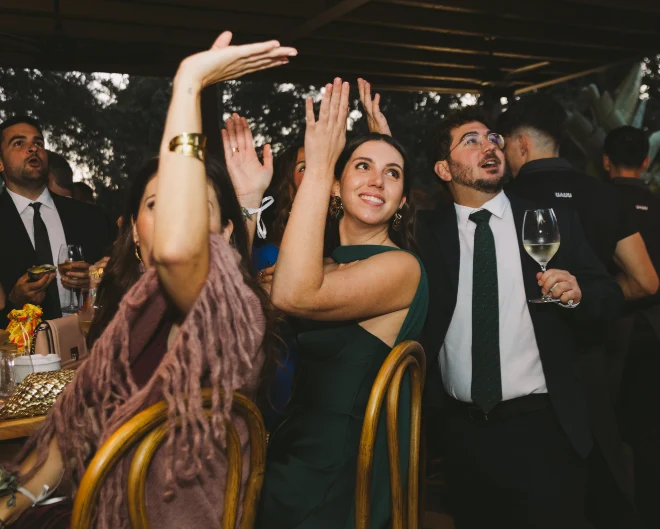
Laura Chacon Photography
Why more and more couples organise a pre-wedding party
The pre-wedding party has its roots in the American rehearsal dinner, a practice dinner held the night before the wedding with close friends and family. In Spain the format has adapted: it tends not to be a rehearsal dinner as such, but a more free-form celebration designed to enjoy quality time with the people who matter most before the big day arrives.
The reasons why it makes sense to organise one are concrete:
- The wedding day goes by very fast. It’s common for the couple to reach the end of the night without having had a proper conversation with almost anyone. The pre-wedding party gives you that time the wedding simply doesn’t allow.
- Out-of-town guests appreciate a proper welcome. If you have family or friends travelling from other cities or countries, the pre-wedding party works as a gathering point and breaks the ice before the ceremony.
- It sets the tone for the following day. When guests already know each other, the wedding flows better. Fewer awkward introductions, more natural conversation.
- It releases emotional pressure. Arriving at your wedding having already celebrated, hugged and toasted with your loved ones makes the big day feel lighter.

Who to invite to a pre-wedding party
There’s no fixed rule, but the logic of the pre-wedding party is intimacy. The most common criteria are:
- Immediate family from both sides.
- Closest friends — the ones who would be there for any important moment.
- Guests coming from out of town who are already in the city the night before.
There’s no need to invite everyone attending the wedding. In fact, doing so undermines the whole format: if you have 120 at the wedding and organise a pre-wedding party for 100, you’re simply running two weddings. The pre-wedding party makes sense when the group is small — between 20 and 50 people as a general guideline, though it depends on each case.
If you’re not inviting everyone, communicate this clearly to avoid misunderstandings. There’s no need for lengthy explanations: simply make it clear that it’s a gathering for the inner circle.

Laura Chacon Photography
When and where to hold a pre-wedding party
The most common timing is the night before the wedding, in cocktail or informal dinner format. If the wedding is in the afternoon, a brunch on the same morning also works well. What you should avoid is letting it run too late: the pre-wedding party should end at a time that allows everyone to rest. As a reference, wrapping up between 11:30pm and 1:00am is the most sensible approach.
As for the venue, the most common options are:
- Private restaurant or reserved room: the simplest format to manage logistically.
- Estate or garden: if the weather cooperates, this delivers excellent atmosphere.
- Terrace or outdoor space: ideal for a summer cocktail.
- Private home: the most intimate option, suitable for small groups.
- The wedding venue itself: some venues allow you to hold the pre-wedding party there the night before, which simplifies logistics for everyone.
At UAUU we work with spaces in Barcelona designed for this type of celebration. [LINK UAUU SPACE 1] and [LINK UAUU SPACE 2] are two of the options that best suit the pre-wedding party format.

How to organise a pre-wedding party step by step
Organising a pre-wedding party doesn’t require the same level of planning as a wedding, but it does call for a few key decisions made well:
- Decide on the format and budget first. A cocktail with finger food and drinks in Spain typically costs between €25 and €35 per person for mid-to-high quality catering. More elaborate formats can reach €40–50 per person. Have this clear before choosing a venue or menu.
- Close the guest list before booking the venue. The number of people determines the space, not the other way around.
- Book the venue in advance. If the wedding is during peak season (spring or autumn), spaces fill up quickly. Don’t leave it to the last minute.
- Choose a light menu, different from the wedding menu. Guests should feel they are attending two distinct celebrations. Finger food, tapas, casual bites: options that encourage conversation without leaving people feeling heavy.
- Set an end time and communicate it. Including it in the invitation (“cocktails from 8pm to 11:30pm”) manages expectations and prevents the night from running longer than intended.
- Music: present but understated. This is not a dance party. Background music or a small live set works better than a DJ at full volume.
- Keep invitations simple. A WhatsApp message or digital invitation is sufficient. The same level of formality as the wedding is not needed.
Atypical Wedding
Frequently asked questions about the pre-wedding party
How much does a pre-wedding party cost?
The cost depends on the format and the number of guests. As a general reference in Spain, a cocktail with mid-to-high quality catering costs between €25 and €35 per person. For 30 guests, you’re looking at between €750 and €1,050 for food and drink alone, not including the venue, decoration or music. More elaborate formats can rise to €40–50 per person. The key is to define the budget before making any other decision.
Do you have to invite everyone from the wedding?
No. The pre-wedding party is designed for a small group: immediate family, closest friends and guests coming from out of town. If you invite everyone from the wedding, you stop having a pre-wedding party and start having two weddings. What matters is communicating this clearly so that no one feels excluded without understanding why.
What is the difference between a pre-wedding party and a pre-wedding photo shoot?
They are two completely different things that share a name and frequently cause confusion. The pre-wedding party is a celebration with guests — dinner, cocktails, barbecue — held the night before the wedding. The pre-wedding photo shoot is a photography session the couple does with their photographer weeks or months before the wedding, without guests, with the aim of feeling natural in front of the camera before the big day. This article is about the party.
At UAUU we have supported hundreds of couples in organising their wedding, including the pre-wedding party. We know that every couple is different and that there is no single formula. If you’re considering organising one and don’t know where to start, we can help you find the format that works for you.