
Some elements of a wedding stay with guests for years. The sweet table is one of them. It is a corner designed for enjoyment, away from the formality of the banquet, where guests drift over, graze, and take photos. A space that, when well organised, becomes one of the most spontaneous moments of the entire celebration.
But behind a wedding sweet table that actually works, there are concrete decisions: what type of table to set up, how much to prepare, how to integrate it into the overall décor, and at what point in the day to bring it out.
In this article we explain everything you need to know to get it right.
What is a wedding sweet table?
A wedding sweet table is a decorated display of sweets, pastries or confectionery that guests can help themselves to freely during the celebration. What sets it apart from other sweet moments at a wedding is that it sits outside the banquet service: it is a standalone element, with its own identity, that works both as a grazing station and as a decorative feature.
Two common confusions are worth clearing up. The wedding cake is a different thing: it has its own moment (the cutting), its own protocol, and is usually served as the dessert at the end of the banquet. The sweet table, by contrast, comes out after the banquet and the cake, during the party, so guests can graze at their own pace.
The candy bar is the best-known version of a wedding sweet table, but it is not the only one. A candy bar focuses mainly on sweets and pick-and-mix confectionery. The sweet table is a broader concept that includes artisan pastry, individual desserts, traditional confections, or combinations of all of the above.
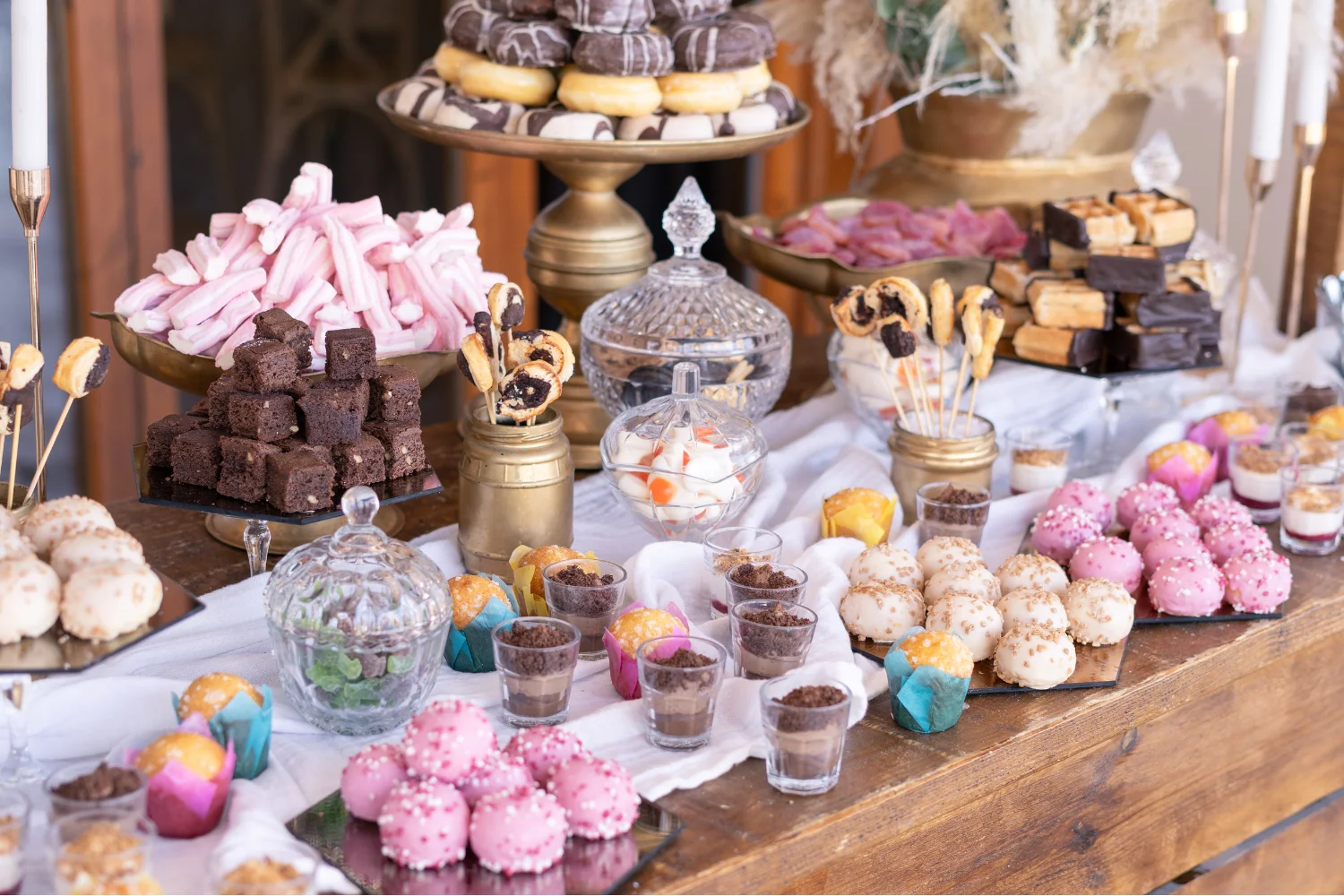
Pallares
Types of wedding sweet table
There is no single format. The choice depends on the style of the wedding, the number of guests, and what you want to convey. The three main formats are:
Pick-and-mix candy bar
The most popular and most recognisable option. Marshmallows, gummy bears, jelly hearts, lollipops, coloured hard candies… all presented in glass jars, dishes or dispensers, with small bags so each guest can put together their own combination. The visual result is colourful and highly photogenic. It works especially well at informal weddings or those built around a defined colour palette, since the sweets can be chosen to match the wedding’s colour scheme.
Artisan pastry table
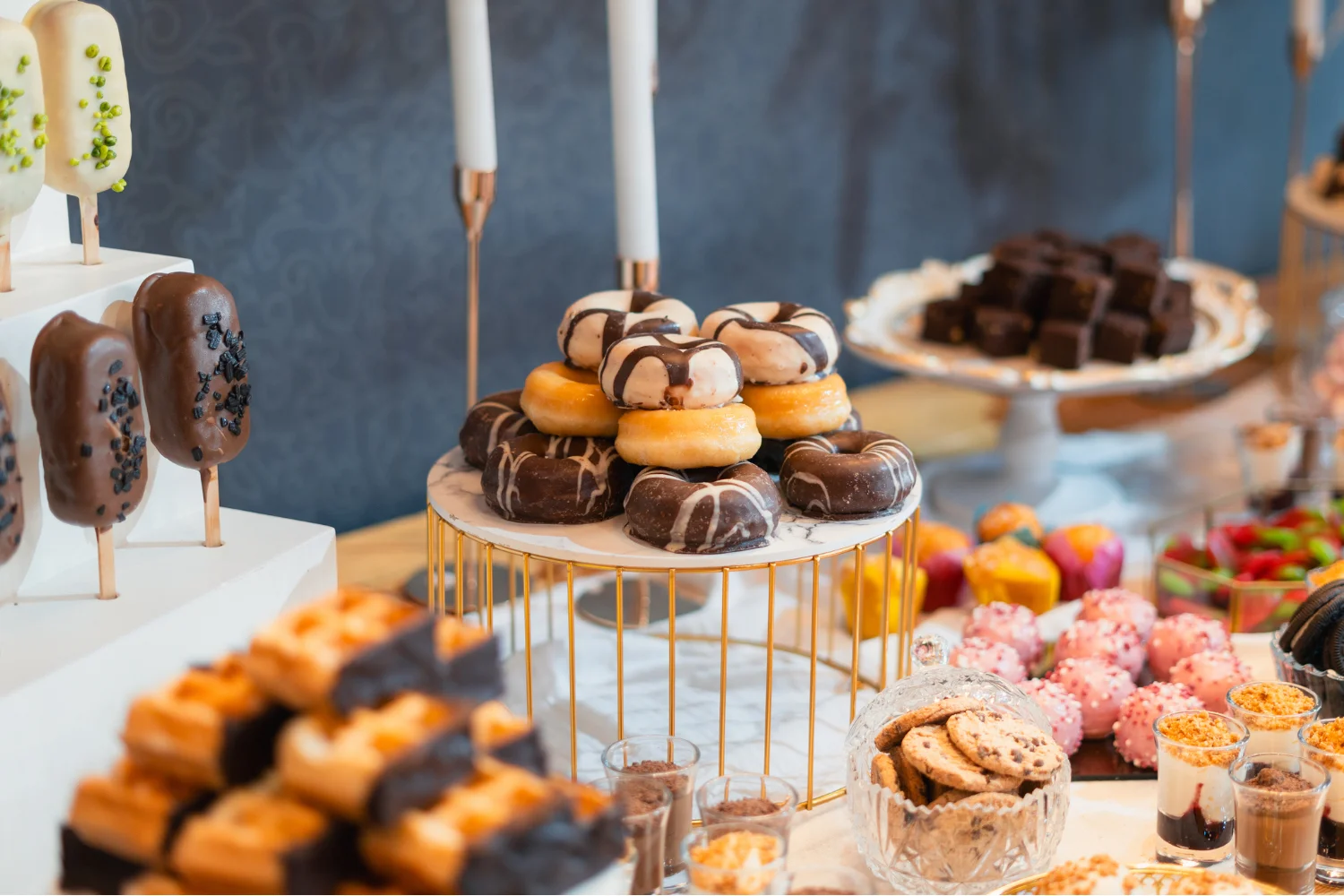
Macarons, brownies, fruit tartlets, mini cheesecakes, cupcakes, personalised biscuits, glazed doughnuts… This format delivers a more elegant and gastronomic result. It requires a greater investment, both financially and in terms of planning, because it involves working with a specialist patisserie or caterer. The elegant wedding sweet table you see in wedding magazines usually follows this format: careful presentation, quality pastry, and aesthetic consistency with the rest of the décor.
A third option, less common but growing in popularity, is to incorporate the sweet table as part of the banquet service: instead of a plated dessert, the catering team sets up a table with individual desserts for guests to help themselves. The advantage is that the cost is included in the menu and the logistics are handled by the caterer. The downside is that it tends to offer less variety and less decorative impact than a table set up specifically for that purpose.

How to organise an elegant wedding sweet table
Setting up a sweet table at a wedding that actually looks good is not just a matter of buying sweets and putting them on a table. There is a logic behind it that makes the difference between an amateur result and one that genuinely surprises.
Decide on the format before choosing the products
Settle on whether you want a pick-and-mix table, an artisan pastry display, or a mix of both. That determines the suppliers you need, the budget, and the set-up requirements.
Quantities, with a clear head
As a general reference, for a pick-and-mix table allow between 150 and 200 grams per guest. For artisan pastry, between 2 and 3 pieces per person. If the table is available throughout the party quantities can be slightly reduced, since not all guests will approach at the same time or with the same appetite after the banquet.
The colour palette, aligned with the overall décor
A wedding sweet table that uses the same tones as the floral decoration, the table linen, or the photocall produces a far more cohesive result. Read our article on wedding decoration for a complete picture of how to fit each element together.
Presentation matters as much as the product
Glass jars, wooden trays, risers, personalised labels, ribbons… A mediocre selection that is well presented can look better than an excellent selection placed without any thought.
Decide when it goes out and for how long
The most common approach is to make the sweet table available during the party, after the cake cutting. Some couples open it during the cocktail hour, but in that case it should be discreet and not compete with the canapés. The table is typically active for between two and three hours.
A key logistical detail: brief the coordinator in advance
If the venue has its own coordinator, let them know early where you want the table positioned, whether you need additional tables, whether any special lighting is required, or whether any items need refrigeration.
Pallares
Ideas for an original wedding sweet table
Beyond the classic candy bar, there are ways to make your wedding sweet table a genuine talking point:
- Personalised biscuits with your initials or the wedding date: easy to source from an artisan bakery, they work both as a table element and as a take-home gift for guests.
- A themed table consistent with the wedding style: a rustic wedding might feature a table with homemade jams, honey jars and village pastries. An elegant wedding might opt for pastel-coloured macarons and chocolate truffles. The sweets can tell the same story as the rest of the décor.
- A mix of sweet and savoury: adding a small section of popcorn, chocolate-dipped pretzels or honeyed nuts gives more options to guests who are not big sweet eaters, and extends how long the table stays in use.
- Something for everyone: including gluten-free, vegan or sugar-free alternatives is no longer unusual: it is a detail that guests with dietary restrictions genuinely appreciate and that many couples overlook. Simply labelling each option clearly is enough.
- Regional traditional sweets: if you are getting married in a space with local roots — such as a historic estate in the comarca de l’Anoia — you can incorporate traditional Catalan confectionery: carquinyolis, panellets, coca de llardons, neules… It is a touch that guests from outside the region particularly appreciate.

How much does a wedding sweet table cost?
The cost varies considerably depending on the format chosen, the number of guests, and whether a set-up service is included. As a general guide:
- Basic pick-and-mix table (no set-up service): between €3 and €6 per guest if you organise it yourselves buying in bulk.
- Pick-and-mix table with set-up service and decorative elements hire: between €8 and €15 per guest, depending on the decoration and variety.
- Artisan pastry table: between €10 and €25 per guest, depending on the quality of the products and the patisserie.
- Full sweet table managed by the caterer: usually included in the menu or quoted as an extra between €5 and €12 per head.
The factors that push the cost up are personalisation (biscuits or packaging with your names, custom colours), artisan pastry versus mass-produced products, hire of decorative elements (risers, glass jars, signage), and an included set-up and clear-down service. If you want a visually striking table without blowing the budget, the key is to invest in the presentation and be selective with the products: a few quality sweets, well displayed, will always outperform a large quantity without any considered arrangement.
Frequently asked questions about the wedding sweet table
How many sweets should you allow per person for a wedding sweet table?
For a pick-and-mix table, allow between 150 and 200 grams per guest. For artisan pastry, between 2 and 3 pieces per person. If the table is available throughout the party, quantities can be adjusted downwards, since not all guests will approach at the same time.
Does the wedding sweet table come out before or after the wedding cake?
The most common approach is to bring it out after the cake cutting, during the party. That way it does not compete with the banquet dessert or the cake moment. Some couples open it during the cocktail hour, but in that case it should be discreet and not interfere with the canapés.
Do you need to label allergens on a wedding sweet table?
Yes. If the table is managed by the caterer or the venue, they are legally required to provide allergen information. If you organise it yourselves, it is strongly recommended to label each product with the main allergens (gluten, nuts, dairy) so that guests with intolerances can choose safely.
Who sets up the wedding sweet table?
It depends on how you have contracted it. If it is going through the caterer or the wedding venue, they handle the set-up. If you organise it with an external supplier, they usually include set-up and clear-down in their fee. If you are setting it up yourselves, you need to coordinate with the venue to know when and where you can access the space to prepare it.
Is a sweet table essential at a wedding?
No. It is an optional extra that many couples include because it adds a festive and photogenic element to the celebration, but it is not a must. If the budget is tight, there are other ways to achieve a similar effect: a savoury snack station, a coffee and liqueur table with small tastings, or simply a small bag of sweets as a guest favour.
Conclusion: the sweet table as an experience element
A well-organised wedding sweet table is not just decoration. It is an experience element: a corner guests gravitate towards on their own initiative, where they linger, interact and take something away with them. The key is choosing the format that fits your style, planning quantities with care, and giving the presentation as much attention as the product.
The space where you celebrate the wedding shapes the result considerably: setting up a sweet table in the courtyard of Castell de Tous or among the stone beams of the Can Macià winery is a very different proposition from a generic events room.
At UAUU we have spent years organising weddings in Barcelona and the surrounding area, and we can help you integrate every detail, including the sweet table, into a celebration that holds together from start to finish.