
Organising the seating at a wedding is one of the tasks that gives couples the most headaches. It’s not just a logistical matter: behind every decision lie family dynamics, friendships from different periods of life, ex-partners, children, elderly relatives and, sometimes, conflicts that have gone unresolved for years. Wedding table arrangements can turn into a labyrinth if not approached with a clear method and a healthy dose of pragmatism.
At UAUU we’ve spent years helping couples organise their weddings in Barcelona and we’ve seen it all. What works is not perfection, but clarity: knowing which criteria to apply and not trying to please everyone at the same time.
Why is wedding table arrangement so complicated?
The problem is not technical, it’s human.
Placing people at a table means making decisions about who gets on with whom, who needs to be close to the couple, who cannot sit next to a certain person and who will feel sidelined if they’re not at the top table.
Add to this that guest lists usually include groups who don’t know each other, families with complex dynamics and friends from different stages of life who have nothing in common. The result is a puzzle with many pieces that don’t always fit together.
The good news is that there is a method that works and will save you hours of arguments.
AtypicalWedding
How to plan your wedding table arrangement step by step
Step 1: Have your guest list finalised
Don’t start arranging tables until the wedding guest list is definitively closed. Every change to the list means redoing part of the work. It’s one of the most common mistakes.
Step 2: Decide the number of tables and their capacity
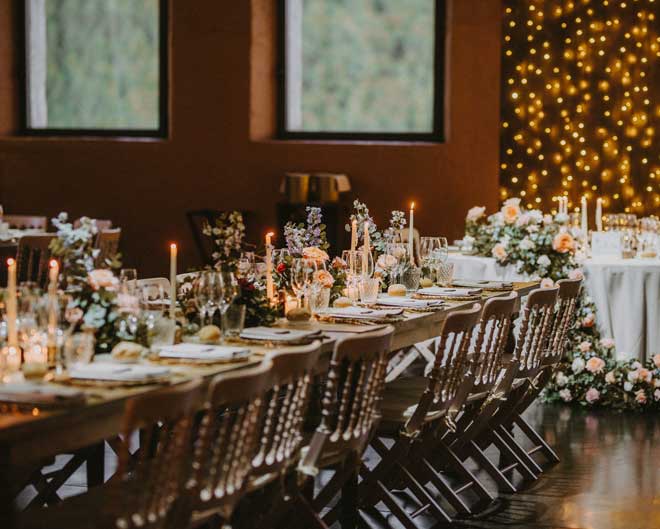
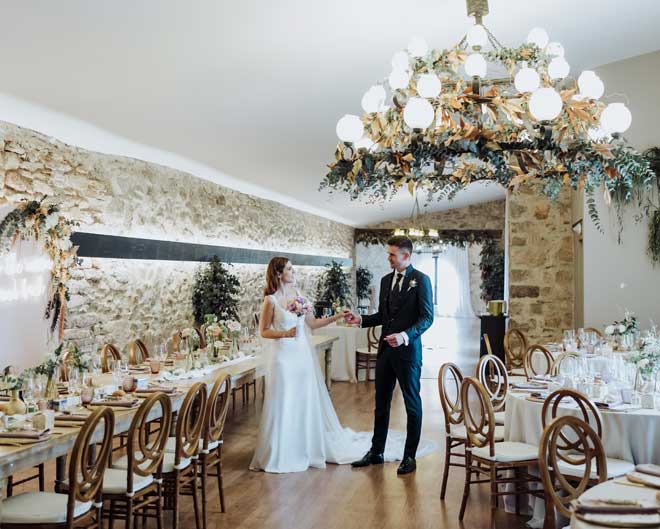
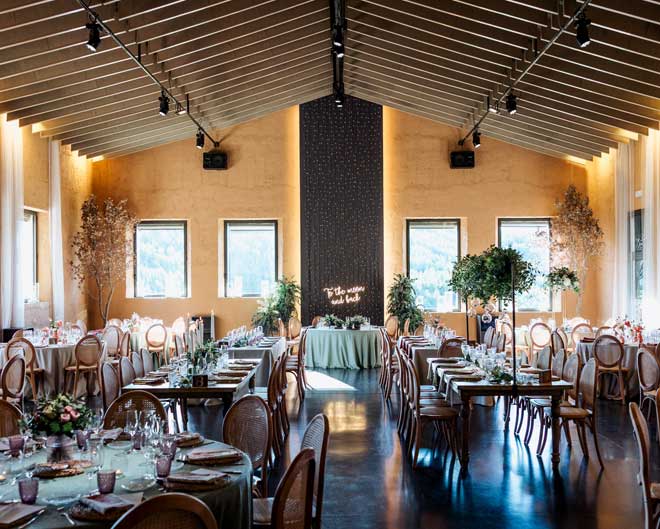
This depends on the venue and the dinner format. Round tables of 8-10 people are the most common at formal weddings. Rectangular tables offer more flexibility but tend to create uncomfortable “end seats”.
Calculate the number of tables you need before you start assigning people. If you have 80 guests and tables of 10, you need 8 tables. Always leave a margin of 1-2 empty seats per table for last-minute changes.
Step 3: Group by affinity, not by category
The most common mistake is grouping by category: “the work friends table”, “the cousins table”, “the school friends table”. This approach works when groups are cohesive, but fails when members of a group don’t know each other or don’t get along.
The alternative is to group by real affinity: people who know each other, have something in common or who you think will connect well. Sometimes it makes more sense to mix groups than to keep them separate.
Step 4: Identify the special cases first
Before you start assigning everyone else, resolve the cases that generate the most tension:
- Separated or divorced families: place them at different, well-separated tables if there is an active conflict.
- Ex-partners: separate tables, with no direct line of sight between them.
- Elderly guests or those with reduced mobility: near the exit, away from the speakers and with easy access to the bathroom.
- Children: their own table or integrated with their parents, depending on age and number.
- Guests who don’t know anyone: place them with open, sociable groups, not with very closed ones.
AtypicalWedding
Step 5: use a visual tool
Trying to work out the table arrangement in your head or in a text document is a recipe for chaos. Use a visual tool: it can be as simple as post-its on a table or as sophisticated as a dedicated seating plan app.
The most commonly used options are:
- Post-its on paper: low cost, easy to move around, ideal for working sessions as a couple.
- Spreadsheet: more organised, allows you to filter and search quickly.
- Seating plan apps: AllSeated, Wedding Wire or Zola have free tools specifically designed for this.
The top table: how many people and how to organise it
The top table is the one that generates the most debate. The main options are:
- Long imperial table: the couple in the centre, flanked by parents, best man, maid of honour and witnesses. Very visual but can feel cold if there are too many people.
- Round table for the couple alone: increasingly popular. The couple at their own table, without family or witnesses. It gives them their own space and allows them to move more freely during dinner.
- No top table: the couple sit distributed among the guests, at different tables. Very informal, works well at small weddings or cocktail-style events.
There is no right option. Choose the one that best suits your style and your families’ dynamics.

Is a cocktail format better to avoid the seating plan?
We get asked this a lot. The honest answer is: it depends.
A cocktail format eliminates the seating plan problem because there are no assigned seats. Guests move freely, eat standing or at high tables and the dynamic is much more fluid. It’s an option that works very well for weddings of fewer than 60-70 people, younger crowds and venues with a good layout.
The downside is that elderly guests, families with young children and guests who don’t know each other may feel uncomfortable without a fixed place. Also, standing for dinner for 3-4 hours has a comfort limit.
A very popular middle ground is the mixed format: cocktail-style aperitif and first part of the evening, followed by a shorter seated dinner with a simplified seating plan.
AtypicalWedding
Practical tips to keep your sanity
- Start early: don’t leave the seating plan until the last week. You need at least 2-3 weeks to do it calmly.
- Decide together but set boundaries: it’s natural for each of you to defend your own family or friends. Set clear criteria before you start to avoid arguments.
- Don’t try to please everyone: it’s impossible. Someone will always be less happy with their seat. Accept it and move on.
- Share the seating plan in advance: if you can, let guests know their table before the day. It reduces confusion and queues at the entrance.
- Have a plan B: there will always be a last-minute change (a cancellation, an unexpected conflict). Leave 1-2 empty seats at strategic tables to absorb surprises.

Frequently asked questions about wedding table arrangements
When should the seating plan be ready?
Ideally, it should be finalised 2 to 3 weeks before the wedding. You need attendance confirmation from all guests before you start, so make sure you have all the replies with enough time to spare.
Do children need to be at a separate table?
It depends on their age and how many there are. If there are more than 6-8 children of similar ages, a dedicated table with a childminder or entertainer makes a lot of sense. If there are just a few young ones, the most comfortable option is for them to sit with their parents.
Do you need to assign seats within the table too?
It’s not compulsory, but it can help at tables where guests don’t know each other. If you only assign the table and leave the seat within it free, guests will sort themselves out. If you want more control over the dynamics at each table, you can also assign individual seats with place cards.
What do we do if someone complains about their seat?
Listen to them, but don’t change the plan at the last minute unless there is a compelling reason. Last-minute changes create a domino effect that complicates everything. If someone has a genuine problem (a serious conflict, an accessibility need), resolve it; if it’s just a preference, stick to the plan.
An arrangement that works for you
The perfect wedding table arrangement doesn’t exist. What does exist is an arrangement that works: one that lets guests enjoy the evening, avoids obvious conflicts and gives you peace of mind on your wedding day.
At UAUU we help you create the seating plan for your wedding with clarity and without drama. Our venues in Barcelona, such as Can Macià or Ca n’Alzina, are designed to adapt to any table arrangement and ensure every guest is comfortable.
Would you like to receive tips and ideas for your wedding?
Subscribe to our newsletter! We help you organise your wedding with tips, practical ideas, trends and much more. Whether you get married with us or not.
Subscribe Loading…
Thank you!
You have successfully subscribed to our newsletter.