
A civil wedding doesn’t have to be cold or impersonal. More and more couples are incorporating civil ceremony rituals that add symbolism, emotion and a personal touch to one of the most important moments of their lives. If you’re thinking about personalising your ceremony and don’t know where to start, here’s a complete guide with the most popular and meaningful options.
At UAUU we’ve spent years organising weddings in Barcelona and we’ve seen how rituals transform a standard ceremony into something truly unique. The key is choosing the ones that connect with your story as a couple.
What are rituals in a civil ceremony?
Rituals are symbolic acts incorporated into the civil ceremony to represent the couple’s commitment, union and values. They have no religious character, although some have their origins in ancient traditions from different cultures.
Their function is twofold: on one hand, they add a moment of emotion and meaning to the ceremony; on the other, they allow guests to actively participate in the celebration. They are not compulsory, but they are becoming increasingly common in modern civil weddings.
The most popular rituals in civil weddings
The handfasting ritual
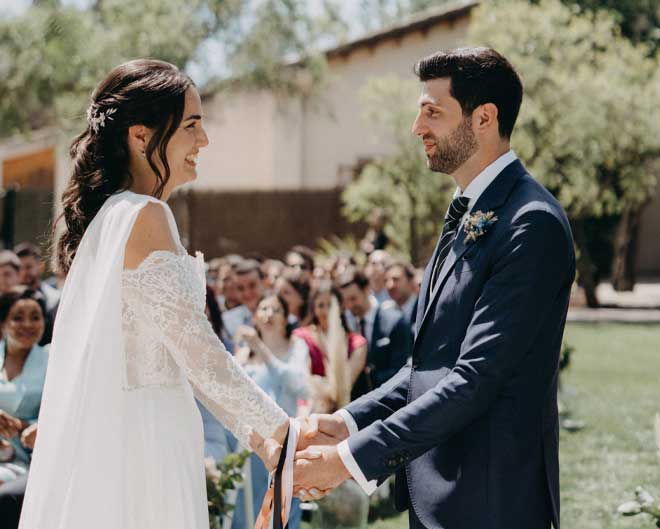
Handfasting is one of the most elegant and visually striking rituals. It involves binding the couple’s hands together with a cord, ribbon or cloth while the vows are spoken. The knot that forms symbolises the union between them.
It has Celtic origins and has adapted perfectly to modern civil weddings. It can be personalised with the wedding colours, special fabrics or cords that have personal significance for the couple.
The unity sand ritual
Each partner pours sand of a different colour into a shared container. The resulting mixture symbolises the union of two lives that, from that moment on, are inseparable. It is especially beautiful when sand from places meaningful to the couple is used (a beach they visited together, for example).
The container is usually kept as a memento and can become a decorative element in the home.
The unity candle ritual
Similar to the sand ritual, but with candles. Each partner lights an individual candle and together they light a third central candle, representing their new shared life. The individual candles can be extinguished or kept lit, depending on the symbolism intended: extinguishing the individual ones represents total fusion; keeping them lit, the preservation of individuality within the union.
Northmiles
The tree planting ritual
The couple plants a tree or seed together during the ceremony. It symbolises the growth of their relationship and the commitment to nurture it over time. It is a particularly meaningful ritual for couples with environmental awareness or a special connection with nature.
The tree can later be planted in the garden of their home, becoming a living witness to their commitment.
The lasso ritual
Very common in weddings of Hispanic tradition. A lasso or floral rosary is placed around the couple’s shoulders in a figure of eight, symbolising eternal union. It is usually placed by family members or people special to the couple.
The wedding coins ritual
Although more associated with religious weddings, the wedding coins ritual can also be incorporated into civil ceremonies. It involves the exchange of thirteen coins that symbolise the commitment to share assets and responsibilities. It is a ritual with deep cultural roots in Spain.

The wine cup ritual
The couple drinks from the same cup of wine, symbolising that from that moment on they will share everything: joys and hardships. In some versions, each partner brings their own wine and they mix it in a shared cup before drinking together.
The guests’ candle ritual
At the start of the ceremony, each guest receives a lit candle. At a given moment, all guests extinguish their candles and the couple lights the unity candle with the flame from their own candles. It is a very visual and participatory ritual that involves everyone present.
The wishes or messages ritual
Guests write a wish or message for the couple on cards that are collected during the ceremony or at the cocktail hour. They can be kept in a special box or read aloud. It is a simple but very moving ritual.
Northmiles
How to choose the right ritual for your wedding?
Not all rituals suit every wedding style or every couple. These are the questions you should ask yourselves before deciding:
- What do we want to convey? Union, growth, guest participation, commitment to nature…
- Does it fit the wedding style? A sand ritual works very well at a beach wedding; handfasting, at a rustic or boho wedding.
- How much time do we have? Some rituals are very brief (2-3 minutes); others can be extended if combined with readings or music.
- Do we want guests to participate? If so, candle or message rituals are ideal.
- Does it have personal meaning for us? The best ritual is the one that connects with your story.
Can several rituals be combined?
Yes, but with judgement. Combining two rituals can enrich the ceremony; combining three or more can make it feel heavy and diminish the emotion of each moment. The ideal is to choose one or two rituals that complement each other and have a clear connecting thread.
For example, handfasting and the exchange of personalised vows work very well together. Or the tree planting ritual combined with a moment of silence and live music.

Who leads the rituals in a civil ceremony?
The master of ceremonies is the person responsible for guiding the rituals during the ceremony. They explain the meaning of each ritual, give instructions to the couple and manage the timing so that everything flows naturally.
If you don’t have a professional master of ceremonies, you can ask someone you trust to take on that role, as long as they are well prepared and familiar with the order of the ceremony.
Frequently asked questions about civil ceremony rituals
Are rituals allowed in a civil ceremony before a judge?
It depends on the court and the judge. Civil ceremonies before a judge tend to be more formal and leave less room for personalisation. If you want to include rituals, the most common approach is to do so in a civil ceremony held in a private venue with a master of ceremonies.
How long does a ritual take in the ceremony?
Between 3 and 10 minutes, depending on the ritual and whether it is accompanied by music or readings. Plan the timing carefully with your master of ceremonies so that the ceremony doesn’t run longer than expected.
Should the ritual be explained to the guests?
Yes, always. The master of ceremonies should briefly explain the meaning of the ritual before performing it. This way guests understand what they are witnessing and can connect emotionally with the moment.
Can we create our own ritual?
Absolutely. Some of the most moving moments in weddings we’ve organised have been rituals completely invented by the couple: a song they played together, an object with history, a gesture only they understand. What matters is that it has meaning for you.
The ritual that represents you
Civil ceremony rituals are a unique opportunity to turn a legal formality into a truly moving and personal moment. There are no right or wrong rituals: there are rituals that represent you and rituals that don’t.
At UAUU we help you organise your wedding step by step, including choosing and staging the rituals that best suit you. Our venues in Barcelona, such as Can Macià or Ca n’Alzina, are the perfect setting for your ceremony to be exactly as you imagined it.
Would you like to receive tips and ideas for your wedding?
Subscribe to our newsletter! We help you organise your wedding with tips, practical ideas, trends and much more. Whether you get married with us or not.